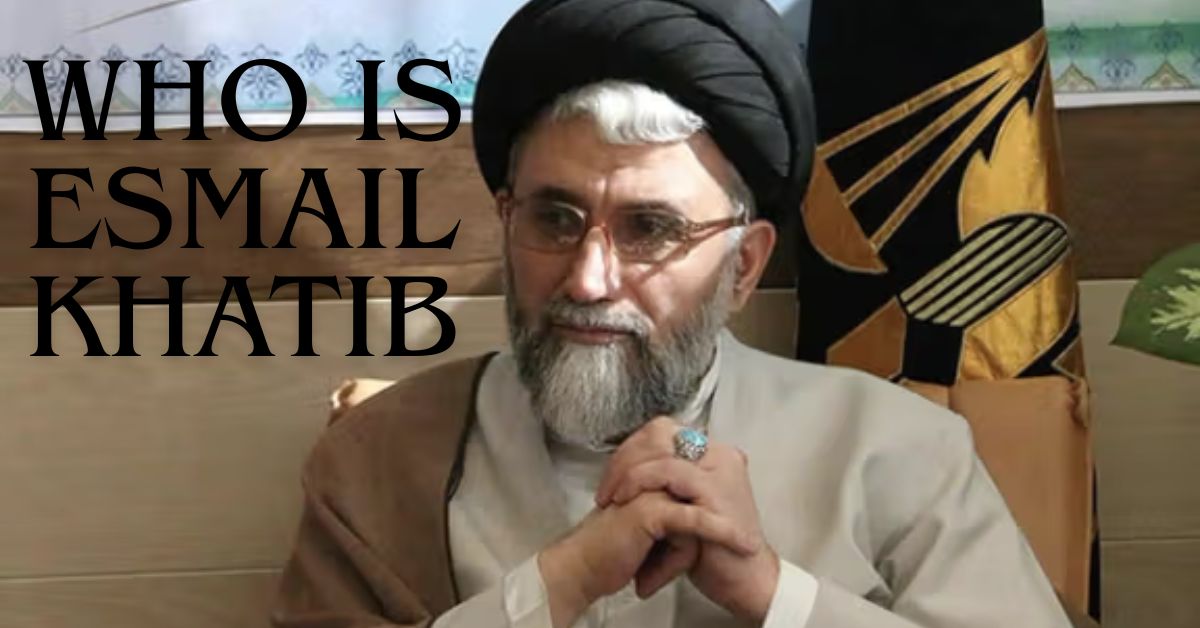
Who Is Esmail Khatib?
Esmail (Esmaeil) Khatib is an Iranian cleric and security official who served as the Minister of Intelligence of the Islamic Republic of Iran from 2021, under President Ebrahim Raisi, and remained a central figure in Tehran’s security establishment into 2026. Trained in religious seminaries and long embedded in the intelligence and security apparatus, he was widely described as a loyalist to Supreme Leader Ali Khamenei and a hard‑line operator within Iran’s internal and external security structure.
International media and analysts portray Khatib as a key architect and overseer of Iran’s Ministry of Intelligence and Security (MOIS) activities, including domestic surveillance, counter‑dissident operations, cyber capabilities, and external intelligence campaigns against perceived enemies such as Israel, the United States, and organized opposition groups.

Early Life and Religious Background
Open‑source profiles indicate that Esmail Khatib was born in 1961 in Qom, Iran’s main religious center, where he pursued studies in Islamic jurisprudence and theology. He reportedly studied under senior clerics close to Khamenei’s circle, which helped position him at the intersection of religious authority and the security state.
From early on, Khatib gravitated towards roles that combined religious legitimacy with intelligence work, reflecting the post‑1979 model where clerics held key security positions. This background made him a natural fit for positions in the Islamic Revolutionary Guard Corps (IRGC), judicial security, and eventually MOIS.
Career Path Before Becoming Intelligence Minister
Khatib’s career spans several pillars of Iran’s security architecture: the IRGC, judiciary security units, and intelligence organizations. Public reports attribute to him roles such as:
- Working in intelligence and security units affiliated with the IRGC in the 1980s and 1990s.
- Serving in security departments of Iran’s judiciary, including protection of judicial facilities and officials.
- Involvement with the Office for the Protection of the Leader, the body tasked with safeguarding Ayatollah Khamenei and his close circle.
These assignments reinforced his reputation as a trusted insider with both religious credentials and security experience.
Key Pre‑Ministerial Positions
Appointment as Minister of Intelligence
In August 2021, President Ebrahim Raisi nominated Esmail Khatib as Iran’s Minister of Intelligence, an appointment approved by the Majlis (parliament) as part of a broader shift toward an even more hard‑line cabinet. Analysts noted that his selection further consolidated Khamenei’s control over MOIS and aligned the ministry more closely with the IRGC’s intelligence arm, which had grown powerful and sometimes rivalrous.
From 2021 onward, Khatib became the public face of MOIS, issuing statements on cyber operations, counter‑espionage, and alleged plots by Israel, Western governments, and exiled opposition groups. His rhetoric consistently framed internal dissent as a foreign‑backed conspiracy, reflecting Tehran’s official line on protests and unrest.
Policy Priorities and Public Positions
Under Khatib, MOIS repeatedly emphasized three broad priorities:
- Crushing internal dissent and protests by portraying them as externally orchestrated and by arresting activists, journalists, and alleged organizers.
- Confronting Israel and Western intelligence services, including public claims of foiling sabotage plots and dismantling alleged spy networks.
- Expanding cyber‑intelligence and offensive capabilities, boasting about hacks and surveillance operations against foreign targets.
In late 2025, for example, Khatib publicly warned of “foreign plots” against Khamenei and accused adversarial states and opposition organizations of trying to destabilize the Islamic Republic, a message aligned with the regime’s narrative that domestic unrest is not organic.
Sample Public Themes in Khatib’s Statements
Role in Repression and Human Rights Concerns
Human‑rights organizations and opposition outlets have portrayed Esmail Khatib as a central figure in the repression of protests, crackdowns on journalists, and operations against ethnic and political minorities. During waves of unrest and demonstrations, MOIS under Khatib was repeatedly accused of arbitrary arrests, coerced confessions, and coordination with IRGC and Basij forces to suppress dissent.
Reports and analyses also tie MOIS, during Khatib’s tenure, to operations targeting Iranian dissidents abroad, including surveillance, cyber harassment, and alleged plots on foreign soil, though Iran typically denies such accusations or frames them as legitimate counter‑terrorism.
External Operations and Regional Dimension
Beyond Iran’s borders, MOIS under Khatib was seen as a key component of the country’s broader regional strategy, often overlapping with IRGC Quds Force objectives. These activities reportedly included:
- Monitoring opposition figures and diaspora media in Europe, North America, and the Middle East.
- Supporting or cooperating with allied militias and non‑state actors aligned with Iran’s regional agenda.
- Gathering intelligence related to Israel, Gulf states, and U.S. forces, particularly in moments of heightened tension.
Analysts noted that Khatib’s tenure coincided with a period of intense shadow conflict between Iran and Israel—spanning cyberattacks, covert strikes, and attacks on shipping—where intelligence services on both sides played prominent roles.

Reported Death and 2026 Escalation
In mid‑March 2026, international news agencies and regional outlets reported that Israel claimed to have killed Esmail Khatib, Iran’s Minister of Intelligence, amid a sharp escalation between the two countries. According to these reports, Israeli officials asserted that Khatib died in a targeted strike, presented as retaliation or pre‑emptive action in the context of ongoing hostilities.
Live coverage described this as a major blow to Iran’s security leadership, given Khatib’s central role in coordinating intelligence and internal security. At the time of reporting, Iranian state media had not fully confirmed all details in the same terms as Israeli and Western outlets, reflecting the usual fog of information in such high‑stakes confrontations.
Key Facts on Reported Death
Because this is a rapidly evolving situation, any long‑form article should clearly time‑stamp information (e.g., “as of March 18, 2026”) and note discrepancies between sources.
Strategic Impact on Iran’s Security Apparatus
If Esmail Khatib’s death is confirmed, analysts expect several short‑ and medium‑term impacts on Iran’s security landscape:
- Leadership transition within MOIS: Tehran would need to appoint an interim or new intelligence minister, likely another trusted figure from Khamenei’s circle or the IRGC, to ensure continuity.
- Potential further alignment with IRGC intelligence: Some observers argue that the IRGC’s intelligence organization might become even more dominant, either overshadowing or tightly integrating MOIS functions.
- Retaliatory calculus: Iran’s leadership may view the killing of a sitting minister as crossing a red line, prompting responses in cyber, proxy, or direct forms, with MOIS planning or facilitating such operations.
Any profile you write can devote a substantial section to exploring these scenarios and comparing them with past episodes where senior Iranian security officials were killed, such as Qassem Soleimani.
Esmail Khatib’s Public Image and Legacy
Within Iran’s establishment, Khatib has been portrayed as a loyal, low‑profile technocrat‑cleric, more operator than public politician. State media coverage generally emphasized his religious credentials, his commitment to “protecting the Islamic Republic,” and his success in allegedly thwarting foreign plots.
Outside Iran, his image has been shaped largely by reports from human‑rights organizations, exiled opposition groups, and Western think‑tanks, which tend to stress his responsibility for repression and external operations. These competing narratives form a crucial part of any nuanced profile.
Contrasting Narratives
How to Turn This into a 3,000‑Word Article
To reach your desired length with a reader‑friendly structure, you can:
- Expand each section above into 3–6 short paragraphs, using very clear sub‑headings (Early Life, Rise Through the Security Apparatus, Appointment as Minister, Policies and Controversies, 2026 Strike and Death, Strategic Impact, Legacy and Assessments).
- Add an FAQ block such as:
- Who was Esmail Khatib and what was his role in Iran?
- When did Esmail Khatib become Iran’s intelligence minister?
- How did Iran’s intelligence policy change under Khatib?
- What do reports say about his death in 2026?
- Include short, neutral explanatory passages about:
- How Iran’s MOIS is structured and how it interacts with the IRGC.
- The broader Iran–Israel “shadow war” context in which his reported killing took place.
As you draft the full article, make sure you:
- Attribute factual claims to reliable sources and time‑stamp fast‑moving developments.
- Keep paragraphs short, use bullets and tables like those above, and stick to neutral, descriptive language rather than advocacy.
You May Also Like – Agra Taxi Service : Book Now | Safe, Affordable Rides , Rent a Car in Agra India 2026: Best Deals & Rates