
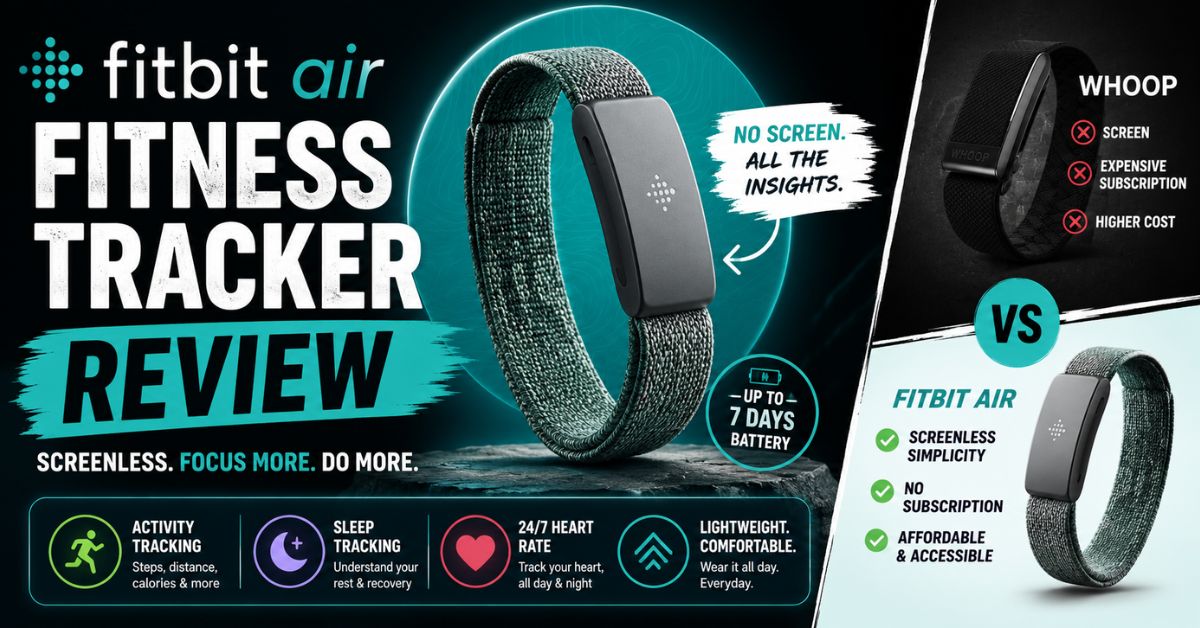
The Fitbit Air, launched in May 2026 by Google, is a game-changing screenless fitness tracker priced at just $99.99, directly challenging Whoop’s subscription-heavy model. This minimalist pebble design prioritizes 24/7 comfort and passive tracking, delivering advanced health insights via the Google Health app. In this comprehensive review, we’ll explore its features, real-world performance, head-to-head comparison with Whoop, subscription details, and why it might be your next wearable upgrade.
Design and Build Quality
The Fitbit Air ditches the screen entirely for a tiny 5.2-gram pebble sensor (12 grams with band), making it 25% smaller than the Fitbit Luxe. Its soft fabric Performance Loop Band uses recycled materials (at least 35% by weight), ensuring all-day comfort without distractions from notifications.
Available bands include a sweat-resistant Active Band for workouts and an Elevated Modern Band for stylish wear. Water-resistant up to 50 meters, it’s gym-ready and shower-safe. Pre-orders started May 6, 2026, with U.S. shelves stocking May 26; a Special Edition costs $129.99, bands from $34.99.
Users love the “invisible” feel during sleep or runs, though some miss on-wrist glances.
This close-up shows the Fitbit Air’s compact pebble nestled in its fabric band, highlighting its featherlight build.
Key Features and Tracking Capabilities
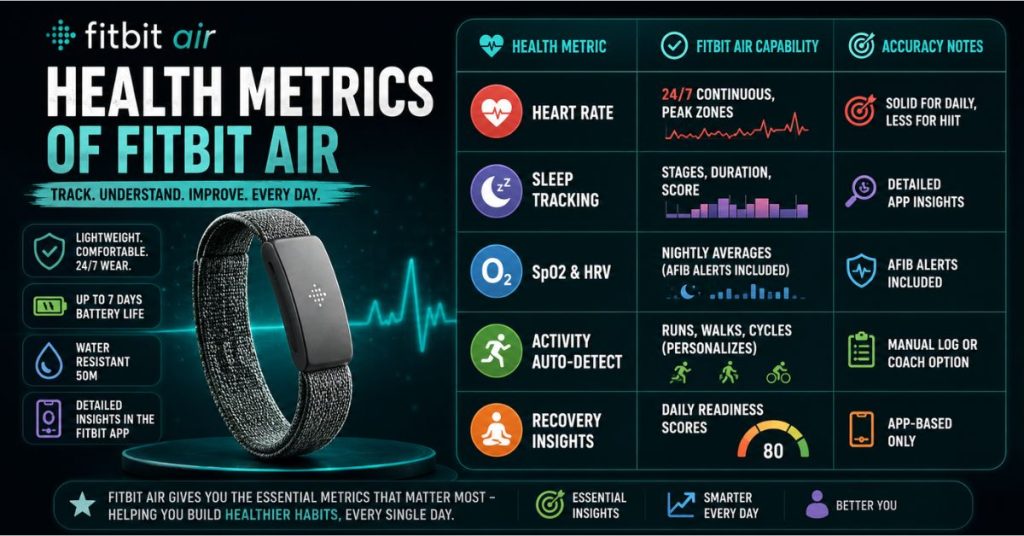
Fitbit Air excels in passive monitoring with traditional sensors for heart rate, SpO2, HRV, resting heart rate, AFib alerts, and sleep stages. Auto-detects workouts like running or cycling, improving via machine learning personalization.
Via the Google Health app (Android/iOS compatible), access adaptive plans, recovery insights, and Google Health Coach for guided sessions—even snap gym equipment photos for custom routines. Pairs seamlessly with Pixel Watch for hybrid use.
Battery lasts a week, with 5-minute fast charge yielding a full day—ideal for forgetful users. No haptic button, keeping it distraction-free.
Health Metrics Table
Battery Life and Charging
Expect up to 7 days per charge, outpacing screen-based trackers. Fast charging delivers 24 hours from 5 minutes, perfect for travel. Real-world tests show 5-6 days with heavy use.
App Experience: Google Health Integration
The revamped Google Health app (formerly Fitbit app vibes) centralizes everything—no screen needed. Features Google Health Coach AI for plans, photo-based workouts, and Premium-exclusive insights. Seamless sync, but app reliance may frustrate minimalists.
Pricing and Subscription Breakdown
At $99.99 upfront, it’s a steal vs. Whoop’s free hardware. Includes 3-month Google Health Premium trial ($9.99/month or $99/year after; bundles with Google AI Pro/Ultra). Cancel anytime, new/returning users only until May 26, 2027.
Subscription Comparison
Fitbit Air vs Whoop: Head-to-Head
Both screenless, but Fitbit Air wins affordability ($99.99 + optional sub vs. Whoop’s $200+/year mandatory). Whoop edges sensor accuracy for pros; Air suits casual users with Google ecosystem perks.
Fitbit Air vs Whoop Comparison
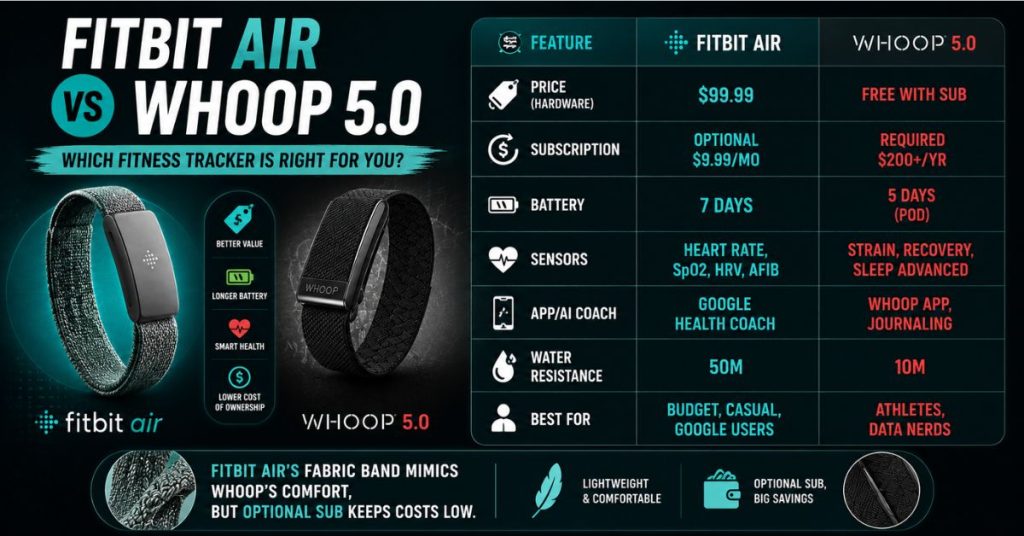
Fitbit Air’s fabric band mimics Whoop’s comfort, but optional sub keeps costs low.
Pros & Cons
| Pros | Cons |
|---|---|
| Ultra-light (5.2g sensor) | App-dependent insights |
| Week-long battery | Traditional sensors limit peaks |
| $99.99 entry + trial | No haptic feedback |
| AI Coach & auto-detect | Bands extra cost |
Real-World Performance Review
Week-long wear: Sleep tracking nailed stages (deep/REM accurate per user reports). Runs auto-detected 90% of the time, app recaps motivational. Heart rate steady for cardio, dipped in HIIT vs. chest straps.
Comfort shines at night—no bulk like smartwatches. Coach feature personalized a beginner’s plan effectively. Battery hit 6 days with notifications off.
Vs. Whoop: Air’s cheaper long-term for light users; Whoop better for pros chasing strain scores.
Who Should Buy Fitbit Air?
Ideal for beginners, budget-conscious fitness fans, or Google loyalists wanting screen-free tracking. Skip if you need ultra-precise athlete metrics (go Whoop) or on-wrist display (try Pixel Watch).
User Scenarios Table
Subscription Deep Dive: Worth It?
Basic mode (free post-trial): Core tracking, auto-detect, simple app views. Premium unlocks Coach, recovery, plans—valuable for $9.99 if committed. Vs. Whoop’s must-pay: Air’s flexibility wins.
Annual $99 beats Whoop’s $200+; bundle perks sweeten it. Test the 3-month trial risk-free.
Accessories and Customization
Bands ($34.99+): Performance Loop (daily), Active (sweatproof), Modern (bracelet). Mix/match for style—elevates from fitness to fashion.
Availability and Deals (May 2026)
Pre-order now via Google Store; ships May 26 U.S. Amazon lists at $99.99; watch for bundles. India launch pending—expect Q2 2026.
Common Questions (FAQ)
Is Fitbit Air better than Whoop?
For most, yes—cheaper hardware, optional sub. Whoop for elite training.
Do I need the subscription?
No for basics; yes for AI Coach/full insights.
Battery really lasts a week?
Yes, 5-7 days typical.
Compatible with iPhone?
Fully, via Google Health app.
Screenless—do I miss it?
Rarely; app fills gaps perfectly.
Final Verdict
Fitbit Air redefines affordable, comfortable tracking in 2026—screenless smartness at $99.99 with Whoop-rivaling vibes minus the commitment. Battery, app, and price make it a winner for 80% of users. Grab it if distraction-free wellness calls.
You May Also Like : Venkatesh Iyer, Jana Nayagan, Katrina Kaif & Vicky Kaushal Parenting, Kurma Jayanti, Jatinder Singh Cricketer, 14 kg Gas Cylinder Price Today Mathura,
Related Articles You May Like:
Agra to Faridabad Cab, Agra to Greater Noida, Agra Taxi Service, Agra to Noida Cab Service, Agra to Gurgaon Cab, 5 Star Hotels in Agra Near Taj Mahal, Mathura Vrindavan Tour from Agra, Banke Bihari Temple Timings, Kharg Island Attack
It’s really interesting how screenless trackers like this one rely entirely on app integration for health insights. I wonder how that impacts user engagement compared to traditional trackers with screens, especially for people who check stats frequently. The shift toward minimalism seems like it could change how we think about daily wearability and convenience.